One matrix.
Everything traceable.
Every learning outcome in this microcredential traces forward to a deliverable, a rubric criterion, and at least one external standard. Every deliverable traces backward to the LOs it assesses. If a row cannot be filled, the design has a gap — the matrix is how you find it.
Coverage in numbers.
The spine of the program at the top level — LOs defined, sessions, deliverables scored, rubric floor criteria, and external frameworks aligned.
Where the curriculum hits the standards.
Crimson cells = full coverage of the framework's relevant strand. Half-squares = partial. Empty = a real gap (worth a faculty-meeting agenda item, not a hand-wave). Use this before diving into the filterable matrix below.
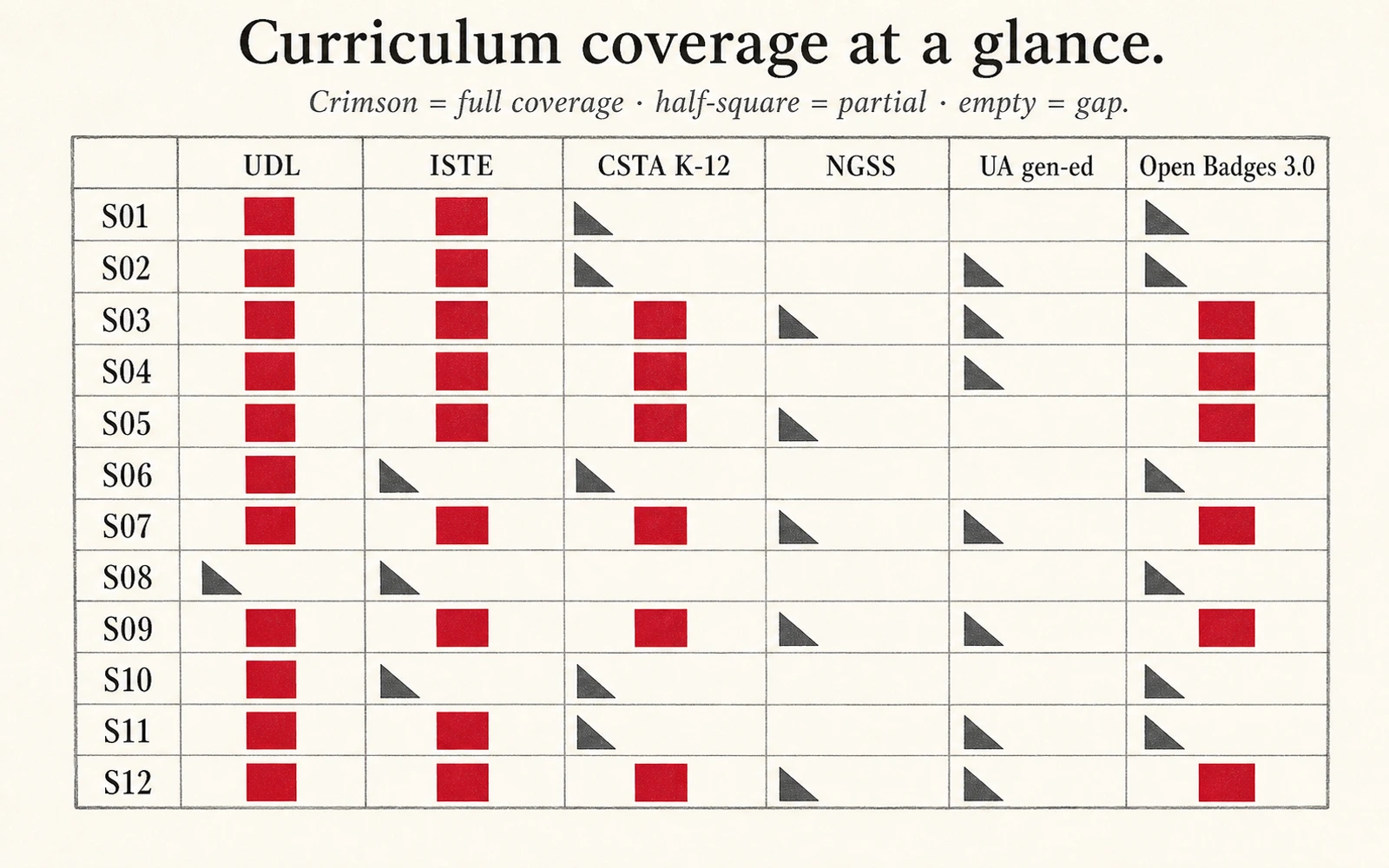
Scope note: this static overview shows six reference frameworks: ISTE Educator Standards, UDL Guidelines 3.0, CSTA K–12 CS Standards, revised 2017, NGSS, UA Core Curriculum, and Open Badges 3.0. The interactive matrix below exposes five direct filters; the UNESCO AI-CFT mapping is shown in the separate table above.
UNESCO AI Competency Framework for Teachers.
Issued credentials embed this mapping in their Open Badges 3.0 alignment[] array,
pointing at the
UNESCO
AI Competency Framework for Teachers (2024) and at this page. The framework has five
competency dimensions; the program hits three of them hard and two of them partially — the
table says which is which, honestly.
Interpretation: “Primary” and “Supporting” describe the strength of the curriculum-to-framework mapping in this program. They are not an external accreditation, UNESCO endorsement, or evidence that every learner has mastered the full framework. Framework version used here: UNESCO AI Competency Framework for Teachers (2024).
| UNESCO AI-CFT dimension | Coverage | Where the program produces evidence for it |
|---|---|---|
| AI pedagogy | Primary | The spine of the program: choosing mechanics that serve stated learning outcomes (D2, LO 3.1–3.5), designing and iterating a GenAI-assisted prototype (D3, LO 7.1–7.5), and playtesting it with target learners (D4, LO 9.1–9.5). |
| Ethics of AI | Primary | The Session 10 audit: excluded populations (LO 10.3), ethical risks and mitigations (LO 10.4), and data-collection disclosure (LO 10.5) — plus the binding AI Use Policy and the declared GenAI provenance log attached to every deliverable. |
| AI foundations and applications | Primary | Applied emphasis: hands-on use of GenAI tools across the design workflow, with documented prompts, outputs, and revisions in the evidence packet (D3–D5 GenAI Design section). The program teaches applied tool fluency, not model internals. |
| Human-centred mindset | Supporting | Learner-first framing in D1 (LO 2.1–2.3) and the UDL strands of the matrix below — addressed through design practice rather than as an explicit unit on human agency in AI systems. |
| AI for professional development | Supporting | Iteration logs, peer critique, and the reflective final submission (LO 12.3–12.4) model AI-supported professional learning; the program does not run a dedicated professional-development strand. |
Filter by session, deliverable, or framework.
Click any chip to filter. Rows show how each learning outcome traces to the activity that produces evidence, the deliverable it feeds, the rubric criterion it maps to, and the external standards it advances.
Version ledger: UNESCO AI-CFT (2024) · UDL Guidelines 3.0 · NETP (2024) · ISTE Educator Standards (current crosswalk) · CSTA K–12 CS Standards (revised 2017; 2026 revision in progress) · NGSS (final release 2013) · UA Core Curriculum (current catalog) · Open Badges Specification 3.0. These are reference mappings, not certification claims; verify the cited source and local version before using the credential for a compliance decision.
Skill tags are working labels inspired by public taxonomies (ESCO, Lightcast Open Skills); the current file still contains identifiers marked TBV (to be verified). They support curriculum discussion but do not establish employer recognition or credential transferability. See skills-crosswalk.json for the full per-criterion mapping.
| LO | Learning outcome | Session | Activity | Deliverable | Rubric criterion | Frameworks | Source / version | Skills (ESCO / Lightcast) |
|---|